


Multisite churches have a unique challenge when it comes to search engines.
Generally speaking, a multisite church is one church congregation that gathers at multiple geographic locations, often referred to as campuses.
If you are a part of a multisite church, you want each individual campus to be shown as close to the top of the search results as possible for the specific city or neighborhood its in.
However, you also want visitors to understand you are one unified church, therefore you probably have just one website.

In the article 3 Ways to Improve Church Search Engine Results, we explain the 3 different types of Google search listings: Paid ads, Local 3 Pack, and Organic Search Results. We’re not going to go into paid ads here, but let’s talk about the other two and how to improve rankings for multisite campuses.
Local 3 Pack: How to improve local search rankings for multisite churches
Local listings are shown in what’s often called the “Local 3 pack” next to a map. They usually look like this:
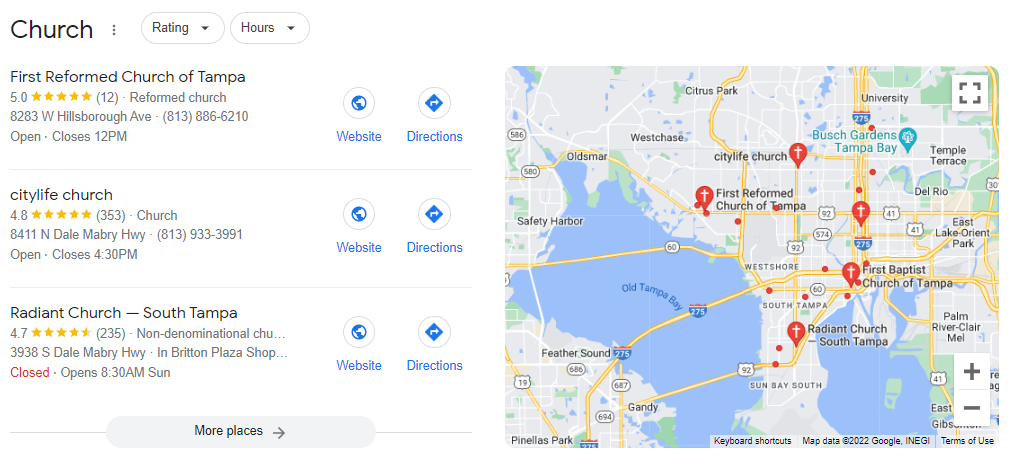
The information in the local listings comes from each organization’s Google Business Profile.
If you want your church to have a local listing in the the Local 3 Pack (and in Google Maps search results), you need to create, claim and verify your Google Business Profile. (Get step-by-step instructions on how to create, claim and verify your Google Business Profile here.)
For multisite churches, this means creating, claiming, and verifying a Google Business Profile for each campus. Plus updating the contact info, description, meeting times for each individual campus in its Google Business Profile.
Organic Search Results: How to improve organic search rankings for multisite churches
Below the Local 3 Pack, are shown the organic search results (sometimes also called general search results). Google usually shows 10 organic search listings per page. (We’re only showing 2 here for the sake of brevity.)
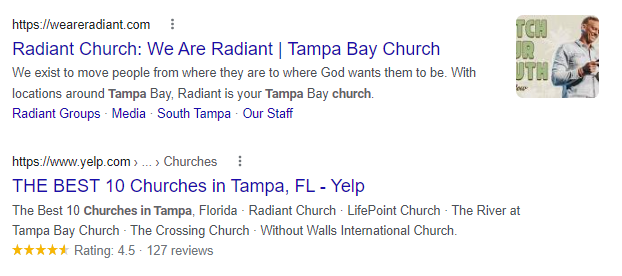
The information in the organic search results is generated by Google and usually comes from the church’s website.
For multisite churches, there are several things that will help to improve the organic search rankings for each campus.
1. Create and optimize at least one web page for each campus.
Use the on-page optimization tactics we explain in Church SEO: What to Optimize for Better Organic Search Results
Make each campus page genuinely useful and unique. Include the campus address, worship times, campus pastor or leader, contact information, photos, ministries or programs available at that campus, directions, parking information, and other details someone considering a visit would want to know.
You can have more than one page for each campus. If you do, there should be one campus hub page that all the other campus-related pages link to.
2. Set each campus’s GBP “website” setting to its campus hub page
The Google Business Profile for each campus has a “website” setting. Some people make the mistake of setting this to the churches homepage (e.g. FirstChristianChurch.org). The better option is to set this to the URL of main page for the campus (e.g. FirstChristianChurch.org/springfield/ )
One exception… If your multisite church has a “main” campus and the other sites are smaller, satellite campuses, it’s fine to set the website setting in the GBP for the main campus to the church homepage.
The important thing, though, is that the GBP for each campus should have a different website setting, pointing people to information about that campus.
3. Link to each campus web page in the website menu.
Google and other search engines discern the importance and authority of the pages in your website from your navigation menu.
If you can list each campus in the top level of the menu, that will help. Another good option is to create a “Locations” menu item with each campus listed in as a sub-menu link.
These SEO fundamentals can also help campus pages appear as sources in Google’s AI-powered search features, including AI Overviews and AI Mode. They can also help you campuses get mentioned in AI tools like ChatGPT, Claude, Grok and Gemini.
More than a decade of multisite church SEO experience
The OurChurch.com team has been helping Christian churches, ministries, and businesses with SEO for more than 15 years.
We frequently customize our SEO services to fit the goals and circumstances of the organizations we serve. As a result, we’ve been providing SEO services for multisite churches for more than a decade.
Our experience is that multisite churches often struggle to keep information about each campus up to date and consistent across the website, Google Business Profile and other local listings. Sometimes they are managed by different people. Sometimes there are old GBPs owned by people who are no longer on staff.
Having a team of experienced SEO professionals working with you to organize the info and listings can be a big help. Click to read more about our Multisite Church SEO service.
Then fill out the form on that page or below (mobile) or to the right (desktop) to schedule a call with one of our church SEO experts.
Comment and Discuss…
- What questions do you have about multisite church SEO?
Continue reading about church SEO


Co-founder & CEO, OurChurch.Com
Paul has been the CEO of OurChurch.Com since its founding in 1996, combining his passion for faith and technology to lead the organization.
An accomplished writer, Paul has authored over 2,000 articles on faith and technology, featured on platforms like ChurchLeaders.com, The JoyFM, and his personal blog, LiveIntentionally.org.
Beyond his professional achievements, Paul serves as an elder at Journey Community Church and is deeply engaged in his community through his involvement with the Florida Sheriffs Youth Ranch and the Safety Harbor Chamber of Commerce. He is a contributing author of the book Outspoken! Conversations on Church Communication.